
Summary
The launch of the National Artificial Intelligence Index (NAII) in Saudi Arabia represents a strategic milestone reflecting the maturity of the national vision and the government’s determination to accelerate the transition toward a knowledge- and innovation-driven economy. Led by the Saudi Data and Artificial Intelligence Authority (SDAIA), the initiative is more than a measurement tool; it is a national compass that organises, directs, and aligns government efforts to adopt AI technologies in line with the ambitions of Vision 2030 (SDAIA, 2025).
Framework and Structure of the Index
Core Dimensions
At its core, the index is built on a comprehensive and unified framework for assessing governmental readiness and maturity in adopting AI solutions. It moves beyond superficial evaluation to diagnose institutional capabilities through a robust structure composed of three main pillars:
- Orientations – covering strategy and governance.
- Enablers – including data, infrastructure, and human capabilities.
- Outcomes – measuring actual applications and tangible impact.
These pillars branch into seven main themes and 23 sub-domains, assessed through 26 precise questions supported by over 480 evidential indicators. This design ensures depth and inclusiveness, offering not only a measurement of each entity’s digital maturity but also practical recommendations and tailored development plans to strengthen performance and close improvement gaps (SDAIA, 2025).
Strategic Significance and Economic Impact
The NAII is closely tied to the objectives of Vision 2030, with 66 out of 96 goals directly or indirectly linked to data and AI. This underscores AI’s centrality to the Kingdom’s future development. According to PricewaterhouseCoopers (PwC, 2019), AI is projected to contribute around $135.2 billion to Saudi Arabia’s GDP by 2030, approximately 12.4 per cent of its economy.
| Title | Title | Title |
The Index acts as both a catalyst and regulator for this growth, guiding public entities to adopt innovative AI solutions that improve operational efficiency, enhance service quality, boost productivity, and create a sustainable competitive advantage. Moreover, it establishes a clear governance framework balancing innovation with ethical responsibility, reinforcing trust in emerging technologies and supporting the Kingdom’s aspiration to become a global AI leader (PwC, 2019; Vision 2030, n.d.).
Measurement Mechanism and Maturity Levels
The Index applies a three-stage assessment process:
- Awareness workshops for government entities.
- Comprehensive questionnaires supported by documentary evidence.
- Data analysis and validation.
Based on results, entities are classified across six maturity levels:
- 0 – Absence of capabilities
- 1 – Building
- 2 – Activation
- 3 – Competence
- 4 – Excellence
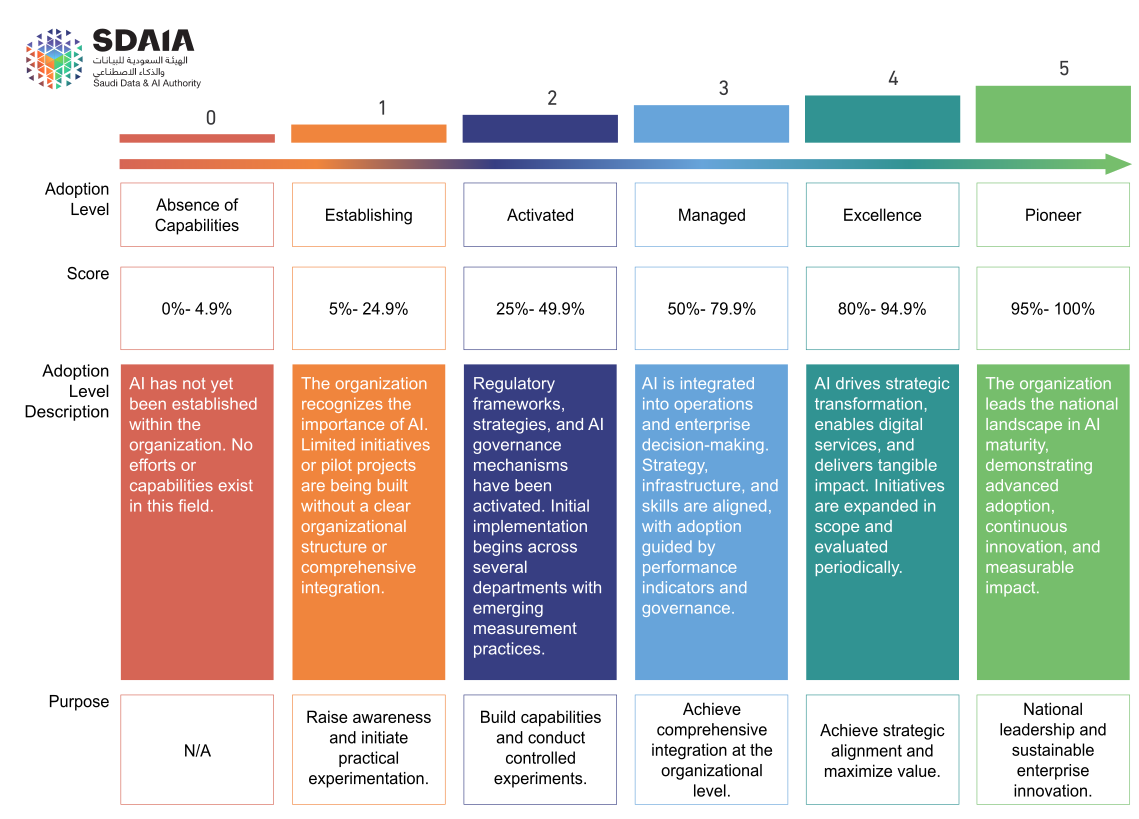
This classification is not a final judgment but a starting point for continuous development, providing each entity with a precise understanding of its current state and a roadmap for advancing capabilities (SDAIA, 2025).
Analytical Insights: AI as a Strategic Necessity
Kaizen AI is no longer optional; it is a strategic necessity. The Index calls for aligning plans and initiatives with national directions, transitioning from limited experimental projects to a systematic adoption of AI within operations and services.
The key challenges include:
- Data quality and governance,
- Skills gaps, and
- Robust, flexible infrastructure.
By measuring these aspects, the Index offers a scientific basis for investment prioritisation, capacity-building programs, and regulatory policy design that accelerates innovation while ensuring responsible and secure AI use (OECD, 2023).
Governance, Ethics, and Organisational Integration
The Index highlights that data quality determines AI quality. It recommends investing in advanced data infrastructure covering collection, cleaning, standardisation, and secure, accessible storage.
A mature data culture should treat information as a strategic asset, governed by rigorous standards of accuracy, completeness, and consistency. It must include source documentation, usage rights, and data-sharing mechanisms across entities to break silos and foster integrated, high-impact solutions.
Enhancing advanced analytics and machine learning capabilities is also essential for extracting actionable insights that support decision-making and improve services (World Bank, 2024).
Technological Infrastructure and Operational Resilience
The Index sets benchmarks for computing, network, and storage capabilities necessary to support AI applications, especially generative and agentic AI models. Entities are encouraged to:
- Invest in high-performance servers with GPUs, or
- Utilise flexible cloud computing aligned with national platforms and standards.
It also mandates provisions for operational resilience, including service continuity, backup and disaster recovery, and proactive monitoring systems that ensure annual availability exceeding 99.5 per cent (ISO, 2023).
Human Capital: The Cornerstone of AI Maturity
stresses building specialised capabilities through integrated strategies that:
- Attract talent via competitive employment programs.
- Foster partnerships with universities and institutes to develop national competencies.
- Invest in advanced professional development aligned with the National Qualifications Framework.
- Create innovation-friendly workplaces that encourage experimentation and career growth.
These measures aim to ensure stability, reduce talent attrition, and embed innovation within institutional culture (World Economic Forum, 2022).
Benchmarking and Continuous Improvement
The Index also provides a benchmarking mechanism, enabling entities to compare their standing nationally and internationally. This fosters mutual learning, accelerates collective progress, and enhances the overall maturity of the national AI ecosystem.
Through periodic measurement cycles, the Index supports progress tracking, evaluates initiative effectiveness, and cultivates a results-based improvement culture. Thus, it becomes a comprehensive enabler accompanying entities throughout their digital maturity journey, from foundational readiness to advanced integration and innovation leadership (SDAIA, 2025).
Transparency, Accountability, and Policy Alignment
By setting unified performance standards linked to institutional KPIs, the Index reinforces transparency and accountability in government performance. Publishing results gives policymakers, researchers, and the public a realistic understanding of AI adoption levels, supporting data-driven decision-making (Transparency International, 2024).
Closing
The National Artificial Intelligence Index acts as a beacon illuminating Saudi Arabia’s digital future. It guides entities toward excellence, warns of pitfalls, and highlights optimal pathways. However, its effectiveness depends on leadership will, sustained investment, and the courage to innovate responsibly.
Entities that engage seriously and invest in capability development will deliver better services, enhanced efficiency, and contribute to a diversified, knowledge-based economy. Those who treat the Index superficially risk falling behind.
Ultimately, the Index transcends evaluation; it embodies an integrated strategic philosophy for building a promising digital future for the Kingdom, providing a common language and unified framework to accelerate AI adoption and transform ambition into measurable achievement.
References
- ISO (2023) ISO/IEC 27001:2022 – Information security, cybersecurity and privacy protection. Geneva: International Organization for Standardization.
- OECD (2023) Artificial Intelligence Policy Observatory: AI governance and national strategies. Paris: OECD Publishing. Available at: https://oecd.ai (Accessed: 12 Nov 2025).
- PricewaterhouseCoopers (PwC) (2019) The macroeconomic impact of artificial intelligence on the Middle East. Available at: https://www.pwc.com/me/aiimpact (Accessed: 12 Nov 2025).
- Saudi Data and Artificial Intelligence Authority (SDAIA) (2025) National Artificial Intelligence Index Framework. Riyadh: SDAIA.
- Transparency International (2024). AI accountability and transparency in public governance. Berlin: Transparency International.
- UNESCO (2021) Recommendation on the Ethics of Artificial Intelligence. Paris: UNESCO. https://doi.org/10.54675/unesco.ai.ethics.2021
- Vision 2030 (n.d.) Saudi Vision 2030. Available at: https://www.vision2030.gov.sa (Accessed: 12 Nov 2025).
- World Bank (2024). Data governance for digital transformation: Global practices and lessons learned. Washington, DC: World Bank. https://doi.org/10.1596/978-1-4648-XXXX-X
- World Economic Forum (2022). The future of jobs report 2022. Geneva: WEF. Available at: https://www.weforum.org/reports/the-future-of-jobs-2022 (Accessed: 12 Nov 2025).