
Summary
In today’s world, data and technology are indispensable for effective decision-making and achieving institutional excellence. The critical question is: How do we align business strategy with data and information technology strategies? This article presents two pioneering models used to achieve this alignment: the Strategic Alignment Model (SAM) and the Amsterdam Information Model (AIM).
The Strategic Alignment Model (SAM)
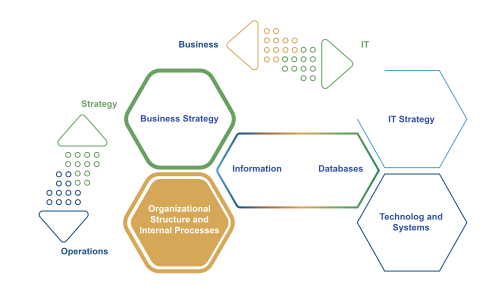
The Strategic Alignment Model (SAM), developed by Henderson and Venkatraman, is designed to create a coherent relationship between business strategies and information technology (IT) strategies. Its purpose is to ensure that data and technology are utilized in a way that supports the long-term goals of the organization.
Components of the SAM Model
- Business Strategy: Defines the organization’s overarching goals and business direction, including elements such as growth, expansion, and competitive excellence.
- IT Strategy: Focuses on how technology is leveraged to support and achieve the goals of the business strategy. It includes the development of technological systems, infrastructure, and applications that enhance efficiency and reduce costs.
- Organizational Infrastructure: Involves the organizational structure and internal processes that support both the business and IT strategies. This includes institutional culture, team structures, and work policies.
- IT Infrastructure: Refers to the core IT systems that ensure the continuity of operations, including servers, networks, and databases that support daily technological usage within the organization.
How the SAM Model Works
The SAM model emphasizes that there must be alignment between these components for success. For instance, the IT strategy should be designed to support the business strategy, not just as standalone systems. Additionally, the organizational infrastructure must be capable of facilitating coordination between business and IT teams.
The Amsterdam Information Model (AIM)
The Amsterdam Information Model (AIM), developed by Abcouwer, Maes, and Truijens, is another framework designed to connect business strategy with IT in an organization. AIM addresses how to manage information within organizations, considering the organizational structure, institutional culture, and tactical approach to enhance the strategic use of data.
Components of the AIM Model
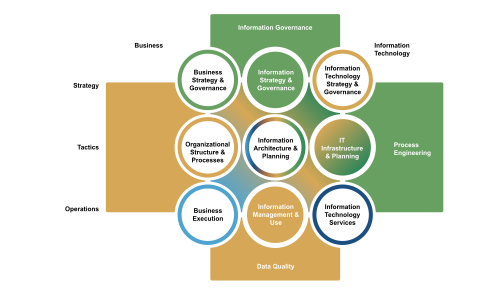
AIM consists of a matrix with nine interconnected cells, divided into three main levels: strategy, tactics, and operations. The model places significant emphasis on data governance and quality in the context of business operations.
- Level 1 – Strategy:
- Business Strategy and Governance: Defines the strategic goals of the organization.
- DATA Strategy and Governance: Directs the information strategies to support decision-making.
- IT Strategy and Governance: Utilizes technology to achieve business strategy objectives.
- Level 2 – Tactics:
- Organizational Structure and Processes: Ensures integration between departments to implement strategies.
- Information Engineering and Planning: Ensures information is stored and organized efficiently for accessibility.
- IT Infrastructure and Planning: Plans the use of IT infrastructure to support the organization’s strategies.
- Level 3 – Operations:
- Business Execution: Translates strategies into actionable tasks and processes.
- Information Management and Usage: Ensures data is managed effectively to support decision-making.
- IT Services: Provides IT services that support business operations and quality.
Relationships Between the Components
The AIM model outlines several interrelated relationships for managing data and IT:
- Horizontal Perspective: Links business strategy with IT strategy.
- Vertical Perspective: Connects business strategy with daily operational activities.
- Data Governance and Quality: Ensures efficient management of data across all organizational levels.
How the AIM Model Works
AIM fosters communication between technical and business teams, ensuring that data strategies align with operational needs. It also strengthens data governance and quality, encouraging improvements that enhance the effectiveness of data use across the organization.
Closing
As organizations face rapid changes, those that successfully align their business strategies with data and technology will be able to lead the market, make smarter decisions, and fully capitalize on digital transformation. Does your organization apply one of these models?
References
- Abcouwer, A., Maes, P. and Truijens, J. (n.d.) The Amsterdam Information Model: Aligning Business Strategy with IT. Available here (Accessed: 14 May 2025)
- Henderson, J.C. and Venkatraman, N. (1993) ‘Strategic alignment: Leveraging information technology for transforming organizations’, IBM Systems Journal, 32(1), pp. 4–16.
- DAMA International (2024) The DAMA Guide to the Data Management Body of Knowledge (DAMA-DMBOK2R). 2nd ed, revised. Sedona, AZ: Technics Publications, LLC.